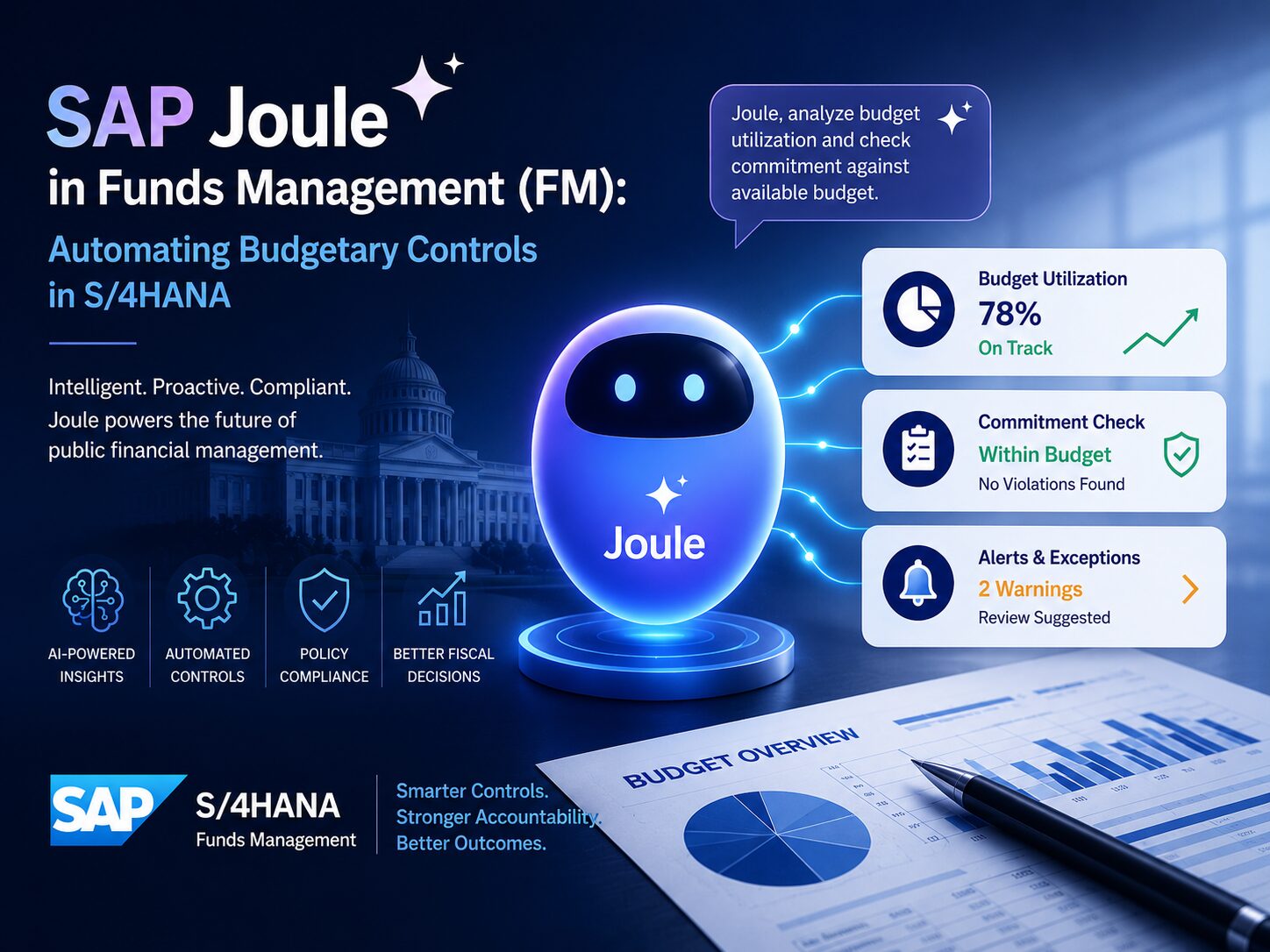

SAP Joule FICO integration is revolutionising how finance teams interact with SAP S/4HANA. This comprehensive guide covers real-world use cases, configuration strategies, and AI capabilities across every major FICO module.
MASTERING SAP JOULE
Real-World FICO Use Cases and Configuration Strategies
1. Introduction: What Is SAP Joule?
The enterprise technology landscape is undergoing a paradigm shift. SAP Joule, SAP’s generative AI copilot embedded natively across the SAP ecosystem, is at the forefront of this transformation. Announced in 2023 and progressively rolled out across SAP S/4HANA Cloud, SAP SuccessFactors, SAP Ariba, and SAP Analytics Cloud, Joule represents SAP’s most significant bet on AI-augmented enterprise workflows to date.
For SAP FICO practitioners — consultants, finance managers, and system administrators — Joule is not merely a chatbot. It is a context-aware, role-sensitive AI assistant that understands SAP data models, transactional intent, and can surface insights, automate repetitive tasks, and guide complex configurations through natural language interaction.
This article covers: Joule’s architecture, real-world applicability across GL, AP, AR, Asset Accounting (AA), and Controlling (CO), and the key configuration strategies practitioners need when deploying Joule in a FICO environment.
2. Joule Architecture: How It Fits into the SAP FICO Landscape
Joule operates as an embedded, cross-application AI layer powered by large language models (LLMs) and integrated with SAP’s Business Technology Platform (BTP). It connects to SAP’s metadata layer and business data in real-time, enabling it to respond with enterprise-grade accuracy rather than generic AI output.
Key Architectural Components
| Component | Description |
|---|---|
| SAP Business AI Foundation on BTP | The underlying compute and orchestration layer hosting Joule’s reasoning engine |
| Role-Based Context Awareness | Joule adjusts responses based on the user’s SAP role (e.g., AP Accountant vs. FI Consultant), ensuring relevant and permissioned outputs |
| Integration with SAP Fiori Launchpad | Joule is surfaced as a persistent chat interface within Fiori, accessible across all FICO apps without context switching |
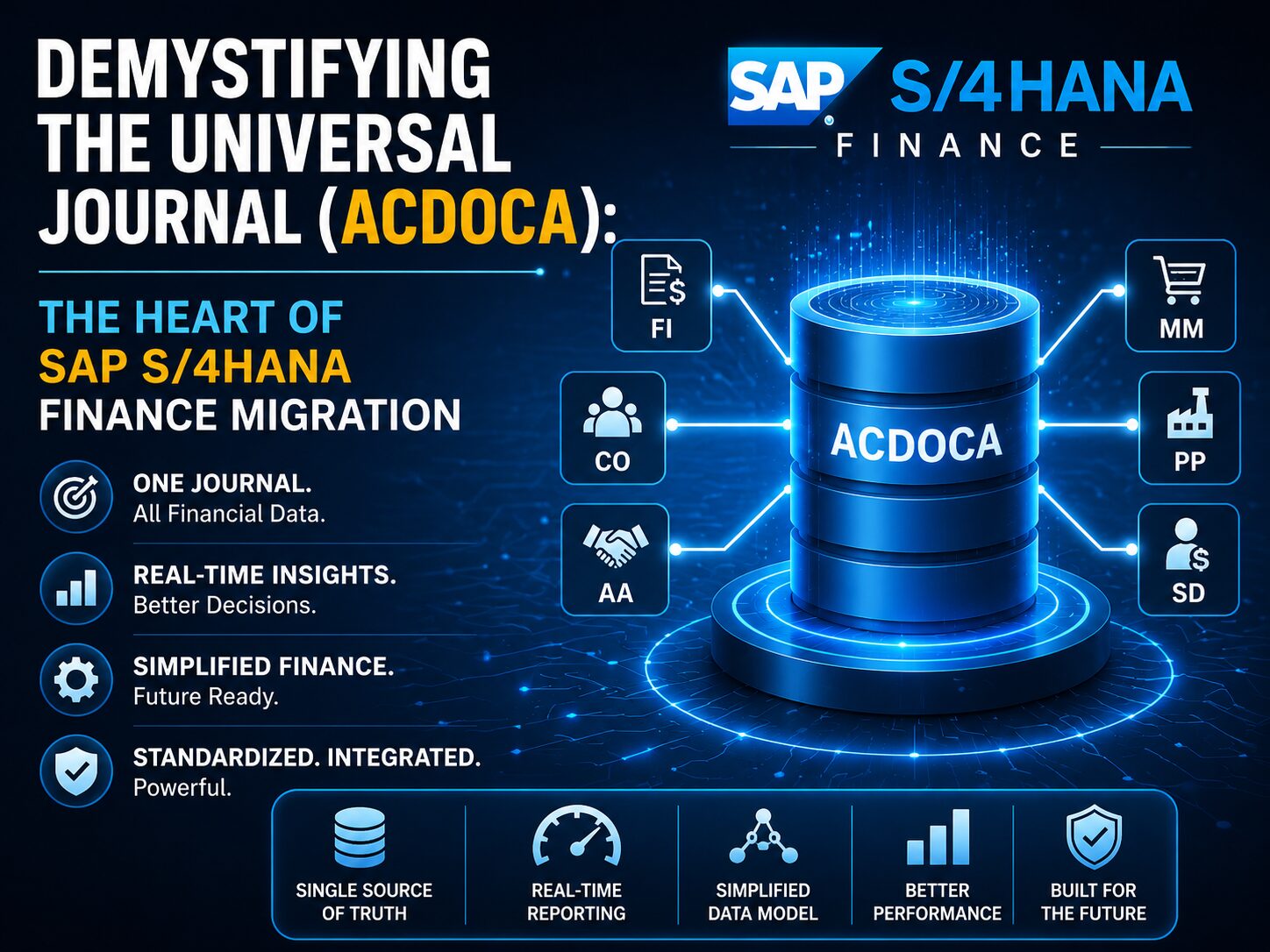
| Real-Time Data Access | Joule reads live data from Universal Journal (ACDOCA), CDS Views, and configuration tables — it does not work on static snapshots |
🏭 Real-World Scenario: At a South African municipal utility running SAP S/4HANA, an AP accountant types into Joule: “Show me all open invoices from vendor 10001 that are overdue by more than 30 days.” Joule instantly queries the backend, presents a summarized list with aging buckets, and offers a one-click option to initiate F110 automatic payment run — without the user navigating a single SAP transaction code.
3. Core SAP FICO Use Cases for Joule
3.1 General Ledger (FI-GL): Period-End Intelligence
Period-end closing is one of the most time-critical and error-prone processes in any SAP FICO environment. Joule transforms this by acting as a period-close intelligent assistant.
- Use Case 1 — Automated Closing Cockpit Guidance: During month-end, users can ask Joule “What tasks are pending in the closing cockpit for Period 6, Company Code JW01?” Joule reads the FINSCLOSCOCKPIT status in real time and lists incomplete tasks with responsible parties.
- Use Case 2 — Posting Period Conflicts: When an accountant tries to post to a closed period, Joule proactively detects the OB52 restriction, explains the cause, suggests the correction action, and even drafts the note to the system admin requesting period re-opening — all in natural language.
- Use Case 3 — Intercompany Reconciliation: Joule can compare intercompany GL balances across company codes and highlight mismatches, reducing what used to take hours of manual comparison into a sub-minute interactive query.
📊 Real-World Scenario — GL Reconciliation: A GL accountant asks Joule: “Are there any unreconciled intercompany postings between JW01 and JW02 for Q2?” Joule surfaces three mismatched entries totalling R 2.4 million, shows the opposing entry details, and suggests the correct clearing documents to post — saving the team an entire day of manual reconciliation.
3.2 Accounts Payable (FI-AP): Invoice Processing and Payment Runs
Accounts Payable is where Joule delivers some of its most tangible efficiency gains, particularly in high-volume invoice environments.
- Use Case 4 — GRIR Discrepancy Resolution: When MIRO fails due to a GR/IR mismatch, Joule identifies the Purchase Order, shows the goods receipt quantity, the invoice quantity, and the tolerances configured in SAP — then recommends whether to adjust the PO, contact the vendor, or post a subsequent debit/credit.
- Use Case 5 — F110 Payment Run Assistance: Finance teams can describe payment intent in plain English: “Run payments for all due invoices for vendors in payment method T, house bank ABSA, due within 7 days.” Joule translates this into the correct F110 parameters and generates a payment proposal for review.
- Use Case 6 — Withholding Tax Validation: In South African SAP environments, withholding tax (WHT) configuration is complex. Joule can instantly validate whether a vendor’s WHT code is correctly assigned, check the exemption certificate validity, and flag mismatches before they cause payment errors.
Joule AP Query Reference Table
| FICO Area | Common User Query | Joule Action |
|---|---|---|
| FI-AP | Why is this invoice blocked? | Diagnoses block reason (price, quantity, quality) and suggests resolution |
| FI-AR | Show overdue customers above R 100K | Queries AR aging, returns ranked list with dunning levels |
| FI-GL | What are unposted parked documents in Period 7? | Lists FBV0 parked documents with posting status |
| FI-AA | Which assets have no depreciation posted this period? | Queries AFAB status and returns exception list |
| CO-CCA | Show cost center variances above 10% for June | Runs KSB1 equivalent query and highlights overruns |
3.3 Accounts Receivable (FI-AR): Dunning and Credit Management
Joule brings intelligence to AR by proactively surfacing collection risks and guiding dunning workflows with precision.
- Use Case 7 — Dunning Level Escalation Analysis: A credit controller asks Joule: “Which customers in dunning level 3 have not paid in 90 days and have balances above R 500,000?” Joule runs the equivalent of F150 simulation, surfaces the at-risk accounts, and drafts customer communication emails for each.
- Use Case 8 — Down Payment Matching: When customer advance payments (Special GL Indicator A) need to be cleared against invoices, Joule guides the F-39 clearing process step-by-step and validates that the correct clearing accounts are configured in OBXR.
- Use Case 9 — Credit Limit Monitoring: Joule can proactively alert when a customer’s exposure approaches their credit limit, pulling data from FD32 and the Sales Order pipeline simultaneously — something that previously required a custom report.
💳 Real-World Scenario — AR Collections: At JHB Water PTY LTD, a credit controller managing Customer 3311022 with a R 6.8 million net credit balance asks Joule: “What is the best way to clear the outstanding debit items against available credit memos?” Joule analyses the open items, recommends F-32 manual clearing with specific document selections, warns against using Charge-Off Difference for paid items, and generates the clearing instruction step-by-step.
3.4 Asset Accounting (FI-AA): Capitalization and Depreciation
Asset Accounting is notoriously complex, with nuanced rules around depreciation areas, transaction types, and prior-year corrections. Joule acts as an expert advisor in this space.
- Use Case 10 — Incorrect Transaction Type Detection: When an asset is created or adjusted with the wrong transaction type (e.g., TType 336 used instead of 100 for a new acquisition), Joule detects the anomaly by comparing the asset class configuration in OAYZ against the posted transaction, and guides the reversal and reposting process.
- Use Case 11 — Depreciation Recalculation Guidance: After a prior-year asset capitalization correction, Joule helps determine whether AFAR (recalculate depreciation) or AFAB (post depreciation) needs to be run, in which sequence, and what the financial impact will be on accumulated depreciation accounts.
- Use Case 12 — WBS-to-Asset Settlement Errors: In project environments using PS-to-AA settlement (CJ88), Joule diagnoses errors like AA629 negative balance or settlement rule mismatches, identifies whether the issue is a transaction type, settlement profile, or date configuration problem, and recommends the corrective action.
🏗️ Real-World Scenario — Asset AA629 Error: A PS consultant faces error AA629 on asset 000001502518 / WBS JW 14472. Instead of spending hours in OSS notes and configuration tables, they ask Joule: “Why am I getting AA629 on this asset?” Joule analyses the asset transaction history, identifies that Transaction Type 115 (retirement) was posted on an asset with zero APC balance due to a partial prior-year settlement, and prescribes the exact reversal and reposting steps — cutting resolution time from days to minutes.
3.5 Controlling (CO): Cost Center and Profitability Analysis
In Controlling, Joule bridges the gap between financial data and business decision-making by enabling plain-language querying of cost and profitability data.
- Use Case 13 — Assessment Cycle Monitoring: Month-end CO assessment cycles (KSU5) often fail silently or produce unexpected allocations. Joule can validate cycle configuration, check for sender/receiver imbalances, and explain why a particular cost center received an unexpected allocation.
- Use Case 14 — Budget vs Actual Variance Analysis: Cost center managers can ask: “Which cost elements on Cost Center 10001 are over budget by more than 15% this quarter?” Joule runs the equivalent of SALR87013611 and presents a prioritized variance list with drill-down capability.
- Use Case 15 — CO-PA Profitability Reporting: For organisations using Profitability Analysis (CO-PA), Joule can interpret CO-PA line items, explain allocation logic, and help configure derivation rules — traditionally one of the most complex areas for FICO consultants.
4. Configuration Strategies for Joule in a FICO Environment
Deploying Joule effectively in an SAP FICO context requires deliberate configuration of both Joule itself and the underlying SAP FICO environment to maximise AI accuracy and relevance.
4.1 Role-Based Access and Persona Configuration
Joule’s responses are governed by the user’s Business Role assigned in SAP BTP Identity and Authentication Service (IAS). FICO administrators must map roles correctly so Joule serves context-relevant prompts to the right users.
SAP_BR_AP_ACCOUNTANT— Enables invoice processing, payment run, and vendor-related Joule capabilitiesSAP_BR_GL_ACCOUNTANT— Unlocks period-close, journal entry, and reconciliation intelligenceSAP_BR_ASSET_ACCOUNTANT— Provides access to depreciation analysis, capitalization guidance, and asset queriesSAP_BR_CONTROLLER— Enables CO-CCA, CO-PA, and internal order querying capabilities
4.2 Universal Journal Optimisation
Joule’s query accuracy directly depends on the quality and completeness of Universal Journal (ACDOCA) entries. Configuration best practices include:
- Ensure all cost objects (cost center, profit center, WBS element) are populated consistently on every journal line
- Activate document splitting (FAGLSPLIT) to ensure segment-level and profit-center-level granularity is available for AI querying
- Maintain consistent use of business areas and functional areas to support multi-dimensional reporting via Joule
4.3 CDS View and Fiori App Availability
Joule’s backend queries rely on Core Data Services (CDS) Views exposed through OData services. For FICO scenarios, ensure the following are active and optimised:
C_GLACCOUNTQ0001— GL account master queriesC_OPENITEMFIARQ— AR open item analysisC_ASSETBALANCEQ— Asset balance and depreciation queriesC_COSTCENTERQUERYQ— Cost center reporting CDS views
Use transaction SICF and the Fiori App Library to validate that backend services are active on your SAP S/4HANA system.
4.4 Master Data Hygiene as a Prerequisite
Joule’s AI intelligence is only as good as the master data it reads. FICO teams should prioritise:
- Vendor and Customer Master completeness — Ensure BP (Business Partner) records have correct payment terms, reconciliation accounts, and tax classifications in S/4HANA
- Asset Master accuracy — Depreciation key, useful life, asset class, and capitalisation date must be accurate for Joule to provide reliable AA guidance
- Cost Center hierarchies — Well-structured standard hierarchies in OKEON enable Joule to give meaningful aggregate and drill-down CO responses
Configuration Impact Summary
| Configuration Area | Key Setting | Impact on Joule |
|---|---|---|
| BTP Role Assignment | Business Role Mapping in IAS | Determines which FICO capabilities Joule exposes per user |
| Universal Journal | Document Splitting Active | Enables segment and profit-center queries in Joule |
| CDS Views / OData Services | Active SICF | Joule backend query accuracy and response speed |
| Master Data | BP, Asset Master, Cost Center completeness | Accuracy of AI-generated insights and recommendations |
| Joule Skill Packs | Industry-specific add-ons (Public Sector, Utilities) | Enables sector-specific FICO query templates in Joule |
5. Practical Limitations: What Joule Cannot Yet Do
While Joule is transformative, SAP FICO practitioners should maintain realistic expectations:
- On-Premise ECC not natively supported: Joule is currently optimised for SAP S/4HANA Cloud (public and private editions). On-premise ECC systems do not natively support Joule without significant BTP integration work.
- Complex configuration still requires consultants: Multi-step configurations — such as new depreciation area creation (OADB) or new GL account assignments — still require consultant intervention. Joule advises but cannot execute high-impact configuration changes autonomously.
- SAP data boundary limitations: Joule operates within SAP’s data boundary. It cannot reference external benchmarks, market data, or documents outside the SAP system unless integrated with SAP Analytics Cloud or Document Management Service.
- Custom Z-table queries may be incomplete: Prompts must be structured around available CDS Views. Queries on custom Z-tables or non-standard data models may return incomplete results.
6. Conclusion: The FICO Consultant in the Age of Joule
SAP Joule does not replace the SAP FICO consultant. What it does is raise the baseline of what a well-configured SAP finance environment can do autonomously — compressing the time between a business question and a data-driven answer from hours to seconds.
For FICO consultants, this means the value of deep functional knowledge does not diminish — it amplifies. Understanding why Joule recommends a particular transaction type reversal, or why a CDS View is returning incorrect results, requires the same deep expertise that has always defined excellent SAP FICO work. Joule simply removes the noise, the repetitive querying, and the navigation overhead — freeing consultants to focus on judgment, not mechanics.
Organisations that invest in clean master data, proper BTP role configuration, and Universal Journal completeness will unlock the full potential of Joule as a force multiplier in their SAP FICO operations.
Key Takeaway
SAP Joule transforms SAP FICO from a system that stores financial truth to one that actively communicates it — in plain language, in real time, and in context.
The future of SAP finance is not AI instead of expertise — it is AI amplifying expertise.
Published on SAP Solution Lab | Category: SAP S/4HANA, AI & Innovation, FICO | Tags: SAP Joule, FICO, AI, S/4HANA, BTP, General Ledger, Asset Accounting, Controlling
SAP Joule FICO: Additional Resources & Further Reading
To deepen your understanding of SAP Joule FICO capabilities and stay current with SAP’s AI roadmap, the following official resources are highly recommended:
- SAP Joule Official Page — SAP’s official product page for Joule with latest feature updates and availability information.
- SAP Joule Help Documentation — Official SAP Help Portal documentation covering Joule setup, configuration, and supported applications.
- SAP Community — Connect with SAP FICO consultants and practitioners sharing real-world SAP Joule FICO experiences and implementation tips.