
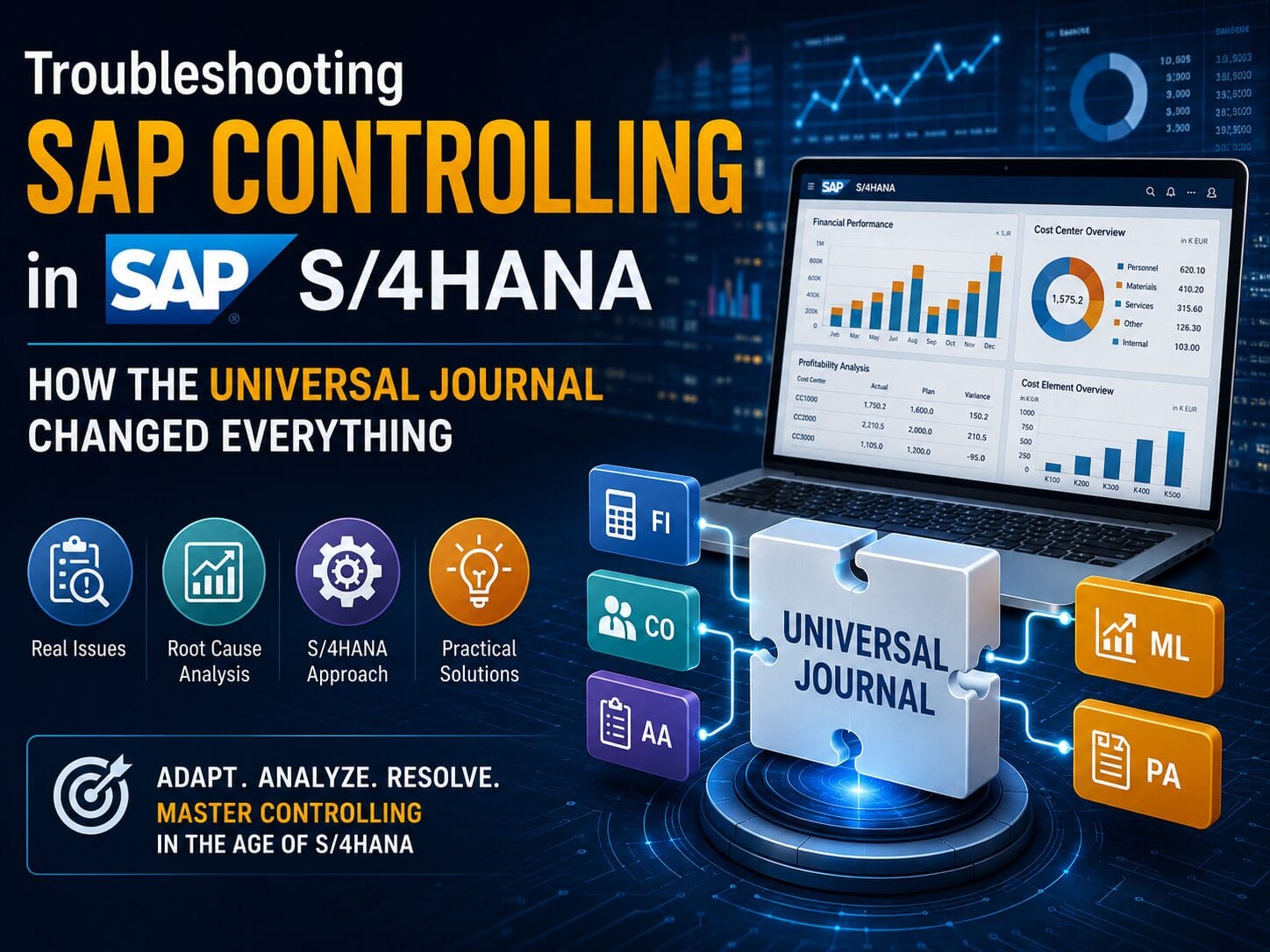
Troubleshooting SAP Controlling in S/4HANA: How the Universal Journal Changed Everything
Why a cleaner data architecture didn’t mean the end of complex CO errors — and what every FICO consultant must know.
For over two decades, SAP Controlling (CO) consultants lived with a fundamental, inescapable reality: Financial Accounting (FI) and Management Accounting (CO) were two different worlds.
In the ECC era, if a journal entry was posted in FI, it had to be passed over to CO. At month-end, finance teams spent countless hours running batch jobs, analyzing KALC reconciliation reports, and investigating why the Profit & Loss statement didn’t match the Profitability Analysis (CO-PA) reports.
With the arrival of SAP S/4HANA, the architecture of Management Accounting underwent a radical transformation. Powered by the Universal Journal (ACDOCA), the artificial wall between FI and CO was destroyed.
1 The Death of the Secondary Cost Element
In legacy SAP, Primary Cost Elements mirrored FI GL accounts, while Secondary Cost Elements (used for internal allocations, assessments, and activity types) existed entirely outside of the General Ledger.
The S/4HANA Shift
In S/4HANA, the master data transaction KA01 (Create Cost Element) is obsolete. It redirects you directly to FS00 (Manage G/L Account). Secondary cost elements are now structurally created as General Ledger accounts (Account Type: Secondary Costs).
The Troubleshooting Impact
When an internal cost allocation cycle (like an Assessment) fails, you are no longer hunting through isolated CO tables (COEP). Because secondary costs are now GL accounts, every single internal allocation writes a line item directly into the Universal Journal (ACDOCA). If a cost center assessment fails, consultants must now check the GL account master data setup (Field Status Groups, Cost Element Categories) just as rigorously as the CO allocation cycles (KSU5).
2 Margin Analysis: The New Standard for Profitability
Perhaps the biggest shock to veteran CO consultants migrating to S/4HANA is the shift in Profitability Analysis. For years, Costing-based CO-PA was the standard. It mapped data into arbitrary “Value Fields” stored in isolated CExxxx tables. Because it didn’t use GL accounts, it rarely reconciled perfectly with the FI P&L.
The S/4HANA Shift
SAP replaced Costing-based CO-PA with Margin Analysis (formerly known as Account-based CO-PA). Margin Analysis is embedded directly within the Universal Journal.
The Troubleshooting Impact
In Margin Analysis, profitability characteristics (Customer, Product, Region) are stamped directly onto the FI line item at the moment of posting. When users complain that profitability reports are missing data, you don’t check value field mappings — you must trace the derivation rules (KEDR) and ensure that the GL accounts involved (especially Cost of Goods Sold and Price Differences) are properly configured to trigger the profitability split in ACDOCA.
3 The Automation of the COGS Split
In ECC, when a product was sold, the Cost of Goods Sold (COGS) hit a single GL account. To see the breakdown of that cost (Labor, Material, Overhead), you had to rely on Costing-based CO-PA.
The S/4HANA Shift
S/4HANA introduced the COGS Split natively in FI/CO. When a goods issue is posted, the system initially hits the main COGS account, but immediately clears it and splits the values into granular GL accounts representing the exact cost components from the material’s standard cost estimate.
The Troubleshooting Impact
If the COGS split fails to post, the P&L loses its granular visibility. Troubleshooting this requires a deep understanding of the Cost Component Structure (OKTZ) and the new S/4HANA mapping profiles. If a new cost component is added to a material but not mapped to a target GL account in the splitting profile, the posting will either fail or dump the balance into an unassigned variance account.
Mastering CO Troubleshooting in the Modern Era
The Universal Journal solved the data reconciliation problem, but it did not solve bad configuration, master data errors, or complex business exceptions.
When a month-end allocation cycle dumps, when an Activity Type fails to calculate correctly, or when Margin Analysis characteristics are blank on a billion-dollar revenue posting, the business doesn’t blame the software — they look to the SAP consultant for a rapid solution. To transition from a functional user to an expert Consultant, you need more than just theory; you need exposure to real-world production issues.
💡 Accelerate Your Expertise with the SAP Controlling (CO) Combo Guide
We have compiled a massive, dedicated toolkit specifically for management accounting: the SAP Controlling (CO) Combo Issue Resolution Guide, packing 360+ Real-Time SAP CO Issues & Solutions across 6 critical sub-modules.
- 🟦 Profitability Analysis (CO-PA) — 60 Issues: derivation rules, mapping, value flows, COGS splits
- 🟨 Cost Center Accounting (CCA) — 60 Issues: assessment/distribution errors, activity type failures
- 🟥 Product Costing (CO-PC) — 60 Issues: standard cost estimates, variance, WIP, settlement failures
- 🟩 Internal Orders (IO) — 60 Issues: settlement rule errors, budget availability control blocks
- 🟧 Profit Center Accounting (PCA) — 60 Issues: document splitting, dummy profit center errors
- ⬜ Cost Element Accounting (CEL) — 60 Issues: primary/secondary cost element setups
🎁 Want to see inside? Grab your free sample copy today to see the exact step-by-step resolution formats we use.
Final Thoughts
SAP S/4HANA has made the Controlling module more powerful, transparent, and immediate than ever before. But with that power comes a demand for a higher caliber of consulting. By understanding the underlying architecture and mastering the resolution of common CO errors, you position yourself as a highly strategic, irreplaceable asset to any finance transformation project.