
RISE with SAP S/4HANA: Public Cloud vs Private Cloud
A Complete Guide to Architecture, Implementation, Benefits, Limitations, Commercial Considerations, and the Decision Framework
With mainstream maintenance for SAP ECC 6.0 scheduled to end in 2027 (extended maintenance to 2030 is available at a premium), most SAP customers must now choose an S/4HANA path.
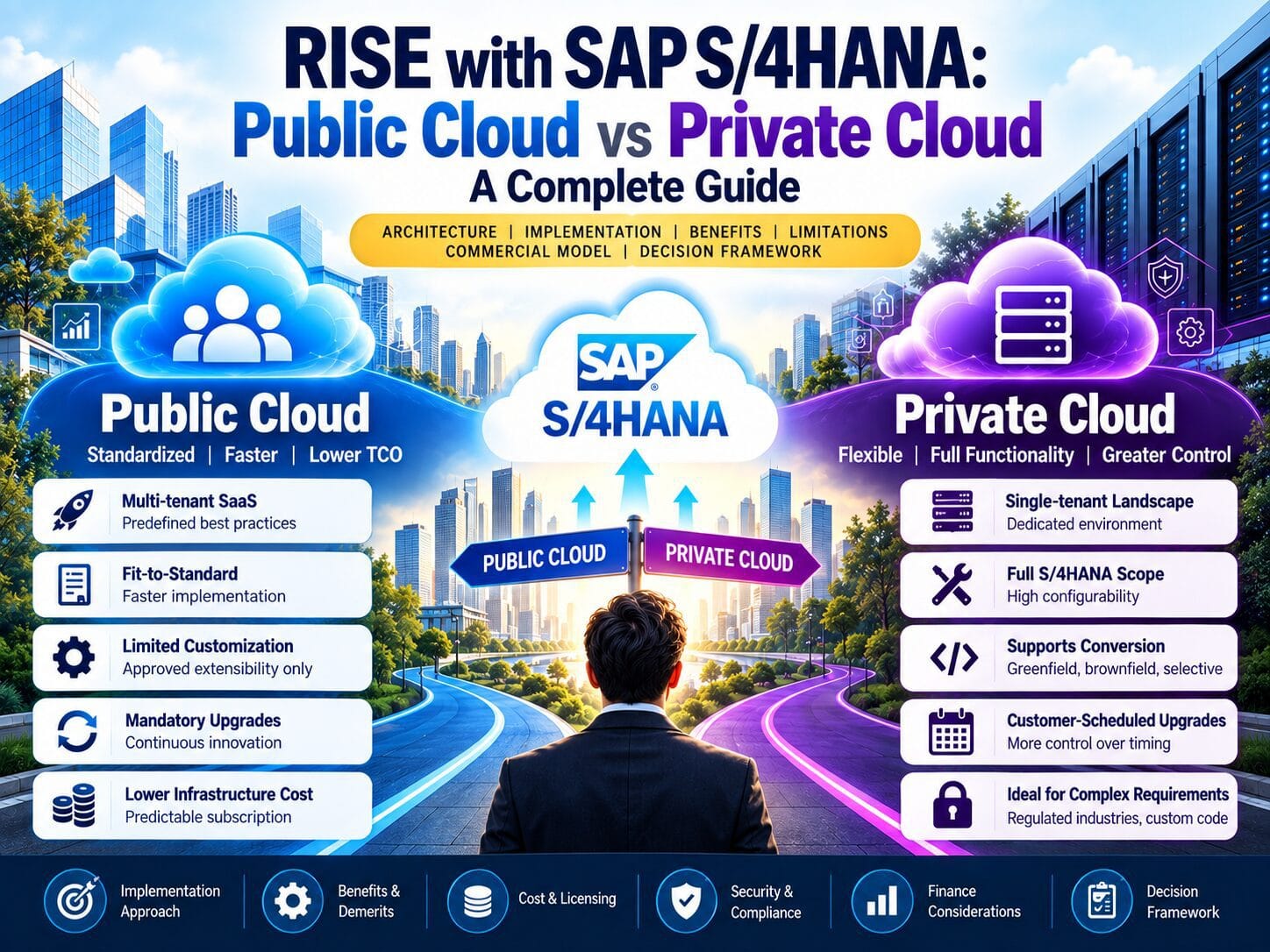
The bigger question is not whether to move but where and how: Public Cloud (multi-tenant SaaS) or Private Cloud (single-tenant, managed).
This choice affects cost, customization freedom, upgrade rhythm, project duration, and how your finance and operations teams work for the next decade.
This article covers both editions in depth: architecture, implementation, merits, demerits, commercial model, and a decision framework.
1. A Note on Naming
Important for Accuracy
SAP's branding has shifted several times, which confuses buyers:
RISE with SAP
RISE with SAP was originally the umbrella offer covering both editions.
RISE & GROW
SAP now positions RISE as the path to S/4HANA Cloud Private Edition, while GROW with SAP is the path exclusively to S/4HANA Cloud Public Edition.
SAP Cloud ERP
In 2025, SAP also grouped both editions under the umbrella name "SAP Cloud ERP".
So in conversations you will hear "RISE Public," "GROW," "Private Edition," and "Cloud ERP" used loosely. Always confirm which product and contract is meant.
Older terms you may still see: Essentials Edition (now Public) and Extended Edition / HANA Enterprise Cloud (older private-style offerings).
2. What Is RISE with SAP?
Business Transformation as a Service
RISE is a business transformation as a service bundle. Instead of buying licenses, hardware, and Basis services separately, you sign one subscription that typically includes:
- S/4HANA software (with the HANA database)
- Cloud infrastructure on a hyperscaler (AWS, Azure, or Google Cloud in the private edition)
- Technical managed services (Basis, monitoring, patching, backups, DR)
- Tools and credits: SAP Signavio, SAP Business Technology Platform (BTP) credits, SAP Business Network starter packs, and migration tooling
- Service-level agreements (availability, RPO/RTO)
Licensing moves from perpetual, named-user licenses to a subscription based on Full Usage Equivalents (FUE), a weighted metric that allows dynamic license allocation.
Consolidating software, maintenance, database, and infrastructure into one fee reduces vendor flexibility, and unused perpetual licenses are effectively lost, although some discounts can be negotiated.
3. Architecture: The Core Difference
| Aspect | Public Cloud Edition | Private Cloud Edition |
|---|---|---|
| Tenancy | Multi-tenant: shared application layer, logically isolated data | Single-tenant: dedicated landscape per customer |
| Code base | Cloud-native, derived from S/4HANA, with fixed scope | Full S/4HANA on-premise code base |
| Hosting | SAP-operated data centers/hyperscaler managed by SAP | Hyperscaler of your choice, managed by SAP |
| Access | Browser/Fiori only, no OS or database access | No OS/DB access in standard RISE, but full IMG and ABAP access |
| Landscape | Typically 3 systems (Starter/Test, Quality, Production) | Customer-defined, typically DEV/QA/PRD plus sandbox |
| Upgrades | Mandatory, SAP-controlled | Customer-scheduled within SAP's support window |
4. Public Cloud Edition: In Depth
4.1 What It Is
A standardized, multi-tenant ERP delivered with SAP best-practice processes (called scope items). Customers adopt predefined processes, tune them through guided configuration, and extend only through approved mechanisms.
4.2 Implementation Approach
Public cloud projects follow SAP Activate with a strong "fit-to-standard" philosophy:
Discover
Business case, edition and scope fit, solution demo.
Prepare
Project team, governance, and system provisioning.
Explore
Fit-to-Standard workshops and gap recording.
Realize
Configuration, data migration and integration.
Deploy
Cutover, testing, and go-live.
Run
Continuous adoption of two major releases per year plus regular hotfixes.
Data migration: Uses the SAP S/4HANA Migration Cockpit (file/staging table approach) to load master and open transactional data. This is a greenfield approach only.
Typical timeline: Often 3 to 9 months for mid-size organizations with tight scope, much faster than traditional greenfield projects.
4.3 Extensibility Options
- In-app (key-user) extensibility: Custom fields, logic, business rules, and CDS views via Fiori apps
- Developer extensibility: ABAP Cloud (restricted, released APIs only)
- Side-by-side extensibility: SAP BTP (CAP, Build Apps, Integration Suite)
You cannot modify SAP standard code, use classic ABAP with unreleased objects, or run arbitrary third-party add-ons on the same stack.
4.4 Merits & Demerits
✓ Merits
- Fastest time to value and quickest go-live
- Lowest infrastructure and operational burden for the customer
- Continuous innovation, including AI (Joule) capabilities
- Lower long-term TCO thanks to standardization and no upgrade projects
- Built-in best practices and pre-packaged business content
- Enforced clean core
- Predictable cost and simpler governance
△ Demerits
- Not for conversion: existing ECC cannot be moved to the Public Cloud edition
- Limited customization
- Mandatory upgrades
- Scope and industry restrictions
- Integration constraints
- Reduced control over data residency, maintenance windows and hardware choices
- Change-management burden
4.6 Best Fit
New implementations, subsidiaries or spin-offs, mid-market firms, fast-growing companies, and organizations willing to "adopt not adapt."
5. Private Cloud Edition: In Depth
5.1 What It Is
The complete S/4HANA on-premise feature set, run as a dedicated, SAP-managed service. It gives full access to the extensibility framework, in-app and side-by-side extensions, code enhancements and modifications, and expert configuration with full IMG access.
5.2 Implementation Approaches
New Implementation
Redesign processes on a clean S/4HANA system, migrating only selected master data and open items.
Best when the legacy system is overloaded with custom code or poor data.
System Conversion
Convert the existing ECC system in place using the Software Update Manager (SUM) with Database Migration Option (DMO).
Selective Data Transition
Uses tools and partner services to migrate selected company codes, history, or entities into a new system while preserving specific configuration.
Suitable for carve-outs, mergers, or consolidating multiple ERPs.
Cross-cutting activities: Data quality clean-up, archiving, authorization redesign, testing automation, integration re-pointing, and organizational change management.
Typical timeline: 9 to 24 months depending on complexity, number of legal entities, and custom code volume.
5.3 The Clean Core Principle
SAP strongly encourages keeping the core standard even in the private edition. Custom logic should move to ABAP Cloud (released APIs only) and BTP side-by-side extensions, which keeps upgrades smooth and avoids re-creating technical debt.
5.4 Shared Responsibility Model
SAP typically handles the infrastructure, HANA database, Basis operations, and technical patching, while the customer or its partner remains responsible for functional configuration, custom code, data, testing, security roles, and application-level support.
Note that application management is generally not included in the standard private subscription, so budget separately for AMS.
5.5 Merits & Demerits
✓ Merits
- Supports brownfield conversion and preserves past investments
- Full functional scope
- High configurability and extensibility
- Control over upgrade timing
- Single-tenant isolation
- Freedom of hyperscaler choice and regional hosting options
- Familiar tooling for existing SAP teams
△ Demerits
- Higher cost
- Slower innovation adoption
- Risk of technical debt
- Longer, heavier implementations
- Vendor lock-in
- Shared operational boundaries
- Restrictions remain on OS/database access and certain third-party tools
5.7 Best Fit
Large enterprises, complex multi-country landscapes, heavy custom-code estates, regulated industries, and existing ECC customers wanting a managed conversion.
6. Side-by-Side Comparison
| Dimension | Public Cloud | Private Cloud |
|---|---|---|
| Ideal for | Standardization, speed | Flexibility, continuity |
| Migration path | Greenfield only | Greenfield, brownfield, selective |
| Customization | Limited | Extensive |
| Release cadence | Frequent + hotfixes | Annual-style, customer-scheduled |
| Update control | SAP-driven | Customer-driven within support window |
| Implementation time | Shortest | Longer |
| Functional scope | Curated best-practice scope | Full on-premise scope |
| Industry/localization | Growing but selective | Broadest |
| Total cost | Lower entry and run cost | Higher |
| Operational effort | Minimal | Moderate |
| Innovation access | First to receive new capabilities | Later, with upgrade effort |
| Tenancy/isolation | Logical | Physical/dedicated |
| Exit flexibility | Low | Low to moderate |
7. Commercial and Contract Considerations
FUE Metric
Users are weighted by type rather than counted equally. Accurate user profiling can significantly reduce cost.
Term Length
Typically multi-year. Negotiate renewal caps and price protections.
Existing Licenses
Credit may be available in some cases, but never assume full value.
Included Services
Verify what "managed" actually covers.
Add-ons
BTP credits, Signavio, extra tenants, and test systems can inflate cost.
Exit Clauses
Data return, transition assistance, and lock-in terms should be clear.
8. Security, Compliance, and Data Residency
Both editions provide certified data centers, encryption in transit and at rest, and role-based access.
- Shared application layer
- Logical tenant separation
- Region selection available but limited
- Dedicated infrastructure
- Customer choice of hyperscaler and region
- More room for customer-managed keys and network-level controls
Regulated sectors such as banking, defense, and some public-sector organizations often lean private, but should validate requirements against SAP's current certifications rather than assuming.
9. A Finance Lens
Because finance teams feel this decision most directly, check these areas carefully:
Universal Journal
ACDOCA is present in both, giving unified FI/CO reporting.
Asset Accounting
New Asset Accounting is mandatory in S/4HANA.
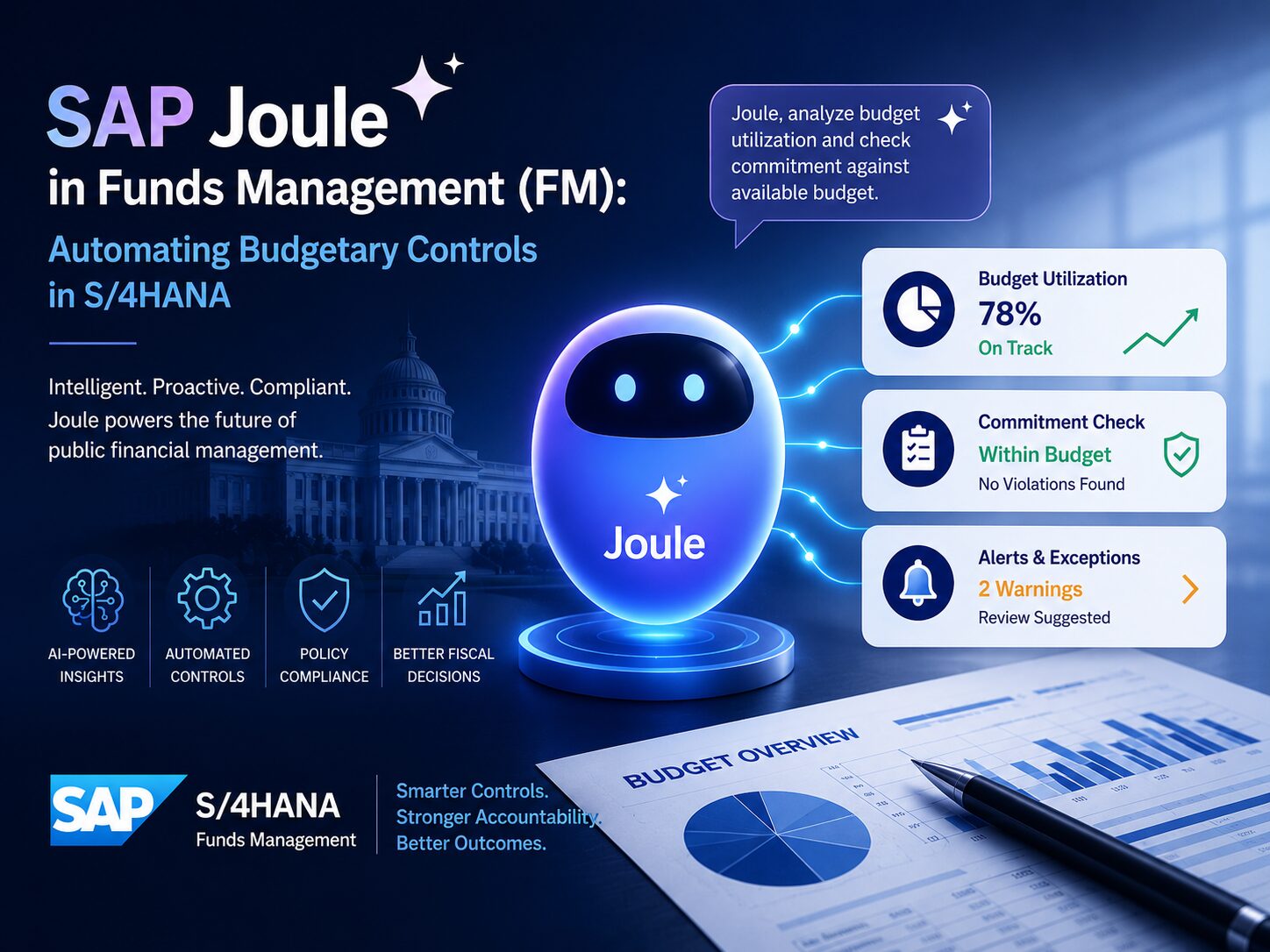
Funds Management
Public edition scope is more limited.
Project System
Public supports standard project scenarios; complex scenarios may need private.
Localization
Statutory reporting, e-invoicing and tax needs must be confirmed.
Reporting
Embedded analytics and Fiori apps exist in both, with greater custom CDS freedom in private.
10. Decision Framework
Ask these questions in order:
- Do we have an existing ECC system we want to convert? If yes and process continuity matters, choose Private.
- Are our core processes largely standard? If yes, Public is worth serious consideration.
- How much custom code do we depend on? High volume points to Private.
- Do we need features or localizations missing in Public? Missing scope forces Private.
- Can the business accept SAP's release schedule? If not, Private.
- How important is speed and low TCO? Strong priority favors Public.
- Any regulatory or data isolation mandates? Assess against Private, then validate with SAP.
11. Common Pitfalls
12. Conclusion
There is no universally better edition.
Public Cloud rewards discipline: standard processes, rapid delivery, continuous innovation, and lower cost.
Private Cloud rewards complexity management: preserving investments, supporting broad functionality, and offering control over pace of change, at higher cost and effort.
The best choice comes from an honest assessment of your process uniqueness, custom-code burden, regulatory context, and appetite for standardization.
Decide with a fit-to-standard workshop, a scope and localization check, and a multi-year TCO model, not with a brochure.