
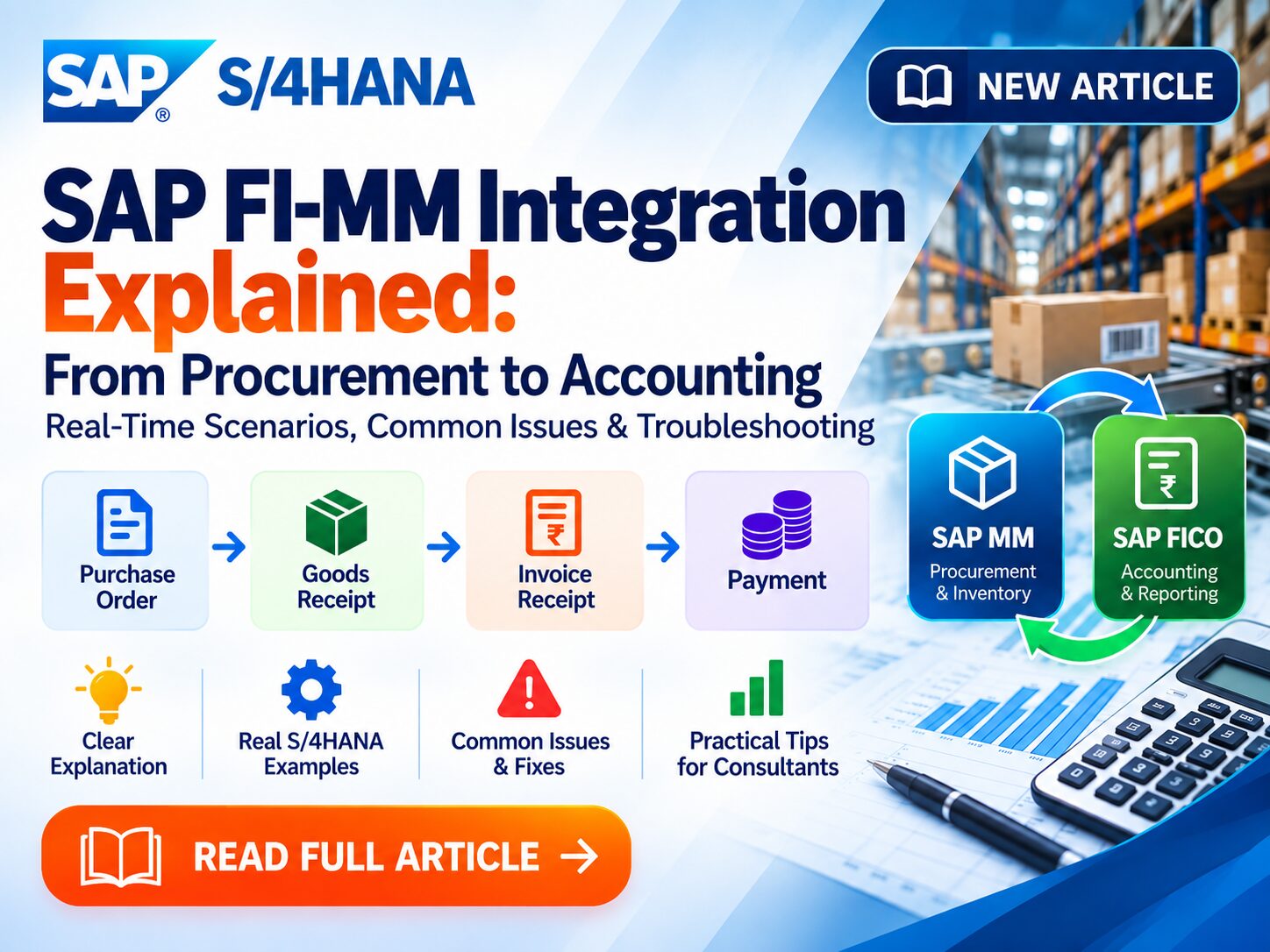
SAP FI-MM Integration Explained: From Procurement to Accounting
Real-Time Scenarios, Common Issues & Troubleshooting
In an SAP S/4HANA implementation, Materials Management (MM) and Financial Accounting (FI) cannot be treated as completely separate areas.
A purchase order may look like an MM transaction, but the moment goods are received or an invoice is posted, the process creates financial implications.
That is why a strong SAP consultant needs to understand both sides:
What is happening in MM? and What accounting impact is created in FI?
The connection becomes especially important during Procure-to-Pay (P2P), where procurement activities ultimately result in inventory, expense, GR/IR, vendor liability, and payment-related accounting.
In SAP S/4HANA, accounting information is integrated into the Universal Journal, with ACDOCA serving as the central accounting line-item structure.
🔗 What Is SAP FI-MM Integration?
SAP FI-MM integration is the connection between:
When an MM business transaction has a financial impact, SAP automatically creates the relevant accounting entries according to the configured business rules.
Purchase Order → Normally no FI accounting document
Goods Receipt → FI impact for valuated stock/procurement
Invoice Receipt → FI impact
Payment → FI/AP impact
🛒 Step 1: Purchase Order Creation
The MM consultant creates a Purchase Order for:
100 units of Material A
Purchase Order price: ₹10 per unit
Total purchase value: ₹1,000
At this stage, the purchase order represents a commitment to purchase.
For a normal stock procurement scenario, the PO itself does not normally create an FI accounting document.
However, the PO contains information that becomes important later, including:
📦 Step 2: Goods Receipt
The warehouse receives the material.
The business posts the Goods Receipt, commonly through MIGO in SAP GUI or the corresponding S/4HANA applications.
100 units are received.
Inventory value: 100 × ₹10 = ₹1,000
For a typical valuated stock-material scenario, the accounting effect is:
| Account | Debit | Credit |
|---|---|---|
| Inventory | ₹1,000 | — |
| GR/IR Clearing | — | ₹1,000 |
MM recorded the physical receipt.FI recorded the financial value.
The inventory account is debited, while the GR/IR clearing account is credited.
🧾 Step 3: Invoice Receipt
The vendor now sends an invoice for:
₹1,000
The invoice is entered through MIRO or the relevant S/4HANA invoice-processing application.
The typical accounting effect is:
| Account | Debit | Credit |
|---|---|---|
| GR/IR Clearing | ₹1,000 | — |
| Vendor | — | ₹1,000 |
The GR/IR account now receives the opposite entry.
💰 Step 4: Vendor Payment
Once the vendor invoice becomes due, Accounts Payable processes the payment.
| Account | Debit | Credit |
|---|---|---|
| Vendor | ₹1,000 | — |
| Bank | — | ₹1,000 |
Procurement → Inventory → GR/IR → Vendor Liability → Bank Payment
🔥 What Happens When the Invoice Price Is Different?
This is where FI-MM integration becomes more interesting.
PO price = ₹10 per unit
Vendor invoice = ₹11 per unit
For 100 units:
PO value = ₹1,000
Invoice value = ₹1,100
The consultant has to understand how the price difference affects accounting.
🧠 The Role of Automatic Account Determination
One of the most important areas in FI-MM integration is automatic account determination.
MM does not simply decide:
“Post inventory to G/L account 140000.”
Instead, SAP determines the relevant account based on configured rules and master-data attributes.
⚠️ Common FI-MM Integration Issues
Goods Receipt Account Determination Error
The user posts a goods receipt and SAP cannot determine
the required account.
Unexpected GR/IR Balance
Goods were received, but the corresponding invoice has
not arrived or does not match the receipt.
GR and IR Quantities Don't Match
Goods receipt and invoice receipt quantities differ.
Invoice Price Differs From PO Price
The invoice value does not match the purchase-order value.
Vendor Invoice Cannot Be Posted
MIRO or invoice processing produces an error.
GR/IR Items Are Not Clearing
Open GR/IR items remain because the related procurement
transactions have not been completely matched.
📋 Consumable Procurement Works Differently
Not every purchase is a stock-material purchase.
For a consumable purchase, the accounting may involve an expense or another account assignment instead of a stock account.
🌐 FI-MM Integration in SAP S/4HANA
S/4HANA makes the integration even more important because financial and logistical information is more tightly integrated.
The Universal Journal provides a central accounting structure, while material-related valuation and movements can also interact with financial reporting.
Think Beyond the Document
Don't ask only: “What document was created?”
Also ask: “What financial information was generated and how does it flow into reporting?”
📊 A Complete FI-MM Integration Example
Material: RM-1000
Vendor: ABC Supplier
Quantity: 100
PO Price: ₹10
Total PO Value: ₹1,000
Step 1 — Purchase Order
PO created for ₹1,000.
FI document: Normally none for the standard PO itself.
Step 2 — Goods Receipt
100 units received.
Typical stock-material accounting:
GR/IR Cr ₹1,000
Step 3 — Invoice Receipt
Vendor invoice = ₹1,000
Vendor Cr ₹1,000
Step 4 — Payment
Bank Cr ₹1,000
🛠️ How to Troubleshoot an FI-MM Issue
When an FI-MM issue occurs, avoid jumping directly into configuration.
🎤 FI-MM Integration Interview Questions
FI-MM integration is one of the strongest areas for scenario-based SAP interviews.
💡 The Real Skill: Think Across Modules
Consider this production issue:
“The warehouse cannot complete the Goods Receipt because SAP is unable to determine an account.”
An MM-only approach may focus on the movement type.
An FI-only approach may immediately search for a missing G/L account.
A strong FI-MM consultant asks:
📚 Build Your FI-MM Knowledge
FI-MM integration sits directly between two major SAP areas. That is why your preparation should cover both sides of the process.
🟢 SAP FICO Materials
Strengthen your knowledge of:
GL • AP • AR • Bank Accounting • Asset Accounting • Cost Element Accounting • Cost Center Accounting • Internal Orders • CO-PA • Product Costing • Profit Center Accounting
Focus on accounting impact, configuration, integration and real-world issue resolution.
Explore SAP FICO Materials →🔵 SAP MM Materials
Strengthen your knowledge of:
Procurement • Purchasing • Inventory Management • Goods Receipt • Invoice Verification • Material Master • Account Determination • Logistics Processes
Focus on procurement, configuration, troubleshooting and FI integration.
Explore SAP MM Resources →🚀 One Article. Two SAP Skillsets.
The strongest SAP professionals don't work in isolated module silos.
A procurement issue can become an accounting issue.
A material-master problem can become an account-determination problem.
A goods-receipt problem can become a GR/IR problem.
And an invoice problem can ultimately become an Accounts Payable problem.
🏆 Final Takeaway
SAP FI-MM integration is not just about accounting entries.
It is about understanding how a business transaction moves through the SAP system.
Procurement → Purchase Order → Goods Receipt → GR/IR → Invoice → Payment
A consultant who understands this complete chain can troubleshoot issues more effectively, communicate better with business users, and handle cross-functional interview questions with greater confidence.
The goal should not be:
The stronger statement is:
“I understand why SAP created this posting, what configuration and master data drove it, and how I would troubleshoot it when the expected result doesn't occur.”
🚀 Build Stronger SAP FI-MM Expertise
Strengthen your SAP FICO and SAP MM knowledge with practical interview preparation and real-world issue-resolution resources from SAP Solution Lab.
📚 Explore SAP Resources