

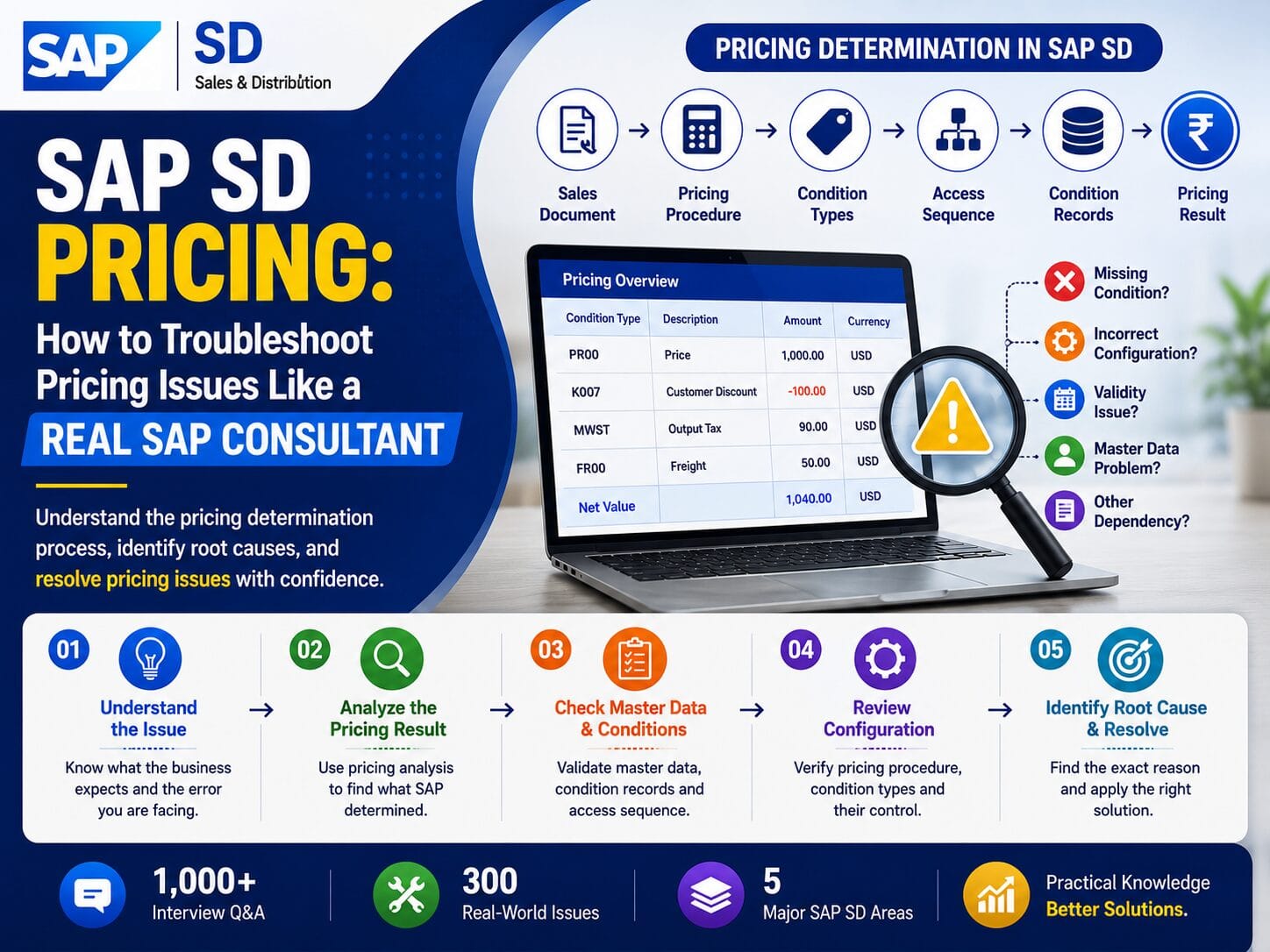
SAP SD Pricing: How to Troubleshoot Pricing Issues Like a Real SAP Consultant
Understand SAP SD pricing, identify common pricing issues, and develop the troubleshooting mindset needed for real-world projects and interviews.
🚀 Why SAP SD Pricing Is More Than Just Finding the Right Price
Pricing is one of the most frequently discussed areas in SAP SD interviews and one of the common areas where consultants face real-world support issues.
A sales order may be created successfully, the customer and material may be correct, and the quantity may look perfectly fine—yet the expected price, discount, surcharge, freight, or tax condition may not appear correctly.
This is where an SAP SD consultant needs more than transaction-code knowledge. You need to understand how SAP determines pricing, where to investigate when a condition is missing, and how to identify the actual root cause.
🔍 How Does SAP SD Pricing Work?
When a sales order is created, SAP determines pricing based on several interconnected elements.
A consultant should understand how these components work together rather than looking at each configuration object independently.
For example, if a discount is not appearing in a sales order, simply checking the condition record may not be enough.
- Is the correct pricing procedure being determined?
- Is the required condition type included?
- Is the access sequence correct?
- Does a valid condition record exist?
- Is the condition record valid for the relevant date?
- Are the required key fields available?
- Is the condition inactive or excluded?
- Is another condition affecting the result?
💡 A Real-World SAP SD Pricing Scenario
Imagine a customer places an order for a material. The business expects a 10% customer discount, but the discount is missing from the sales order.
What should you do?
A beginner might immediately create another condition record. An experienced consultant will investigate the complete pricing determination process.
1Check the Sales Order
Verify the pricing conditions in the sales order and determine whether the expected condition type is determined, missing, inactive, manually entered, or excluded.
2Check the Pricing Analysis
Analyze how SAP attempted to determine the condition. This can help identify whether the issue is related to condition records, access, requirements, validity, or pricing configuration.
3Check the Condition Record
Verify that the relevant condition record exists and is valid for the appropriate customer, material, sales organization, distribution channel, validity period, and pricing key combination.
4Check the Configuration
If the condition record exists but the condition is still not determined, investigate the relationship between the pricing procedure, condition type, and access sequence.
5Identify the Root Cause
Don't stop after finding the first error. Determine why SAP failed to determine the expected pricing condition.
🎯 Common SAP SD Pricing Questions Interviewers Ask
Pricing is an excellent interview topic because it allows interviewers to move from basic concepts into configuration and real-world scenarios.
📌 Conceptual Questions
📌 Configuration Questions
📌 Scenario-Based Questions
🛠️ Pricing Troubleshooting: Think Like a Consultant
1️⃣ Understand the Business Requirement
What price, discount, surcharge, freight, or tax should SAP determine?
2️⃣ Reproduce the Issue
Create or analyze the relevant sales document and reproduce the behavior.
3️⃣ Analyze the Pricing Result
Identify which condition is missing, incorrect, inactive, or unexpectedly determined.
4️⃣ Trace the Determination
Follow the pricing logic and identify where the expected condition failed.
5️⃣ Validate Master Data
Check whether the required condition records and relevant master data are maintained correctly.
6️⃣ Check Configuration
Review the relevant pricing configuration and its relationship with the business requirement.
7️⃣ Determine the Root Cause
Don't simply apply a workaround. Understand why the issue occurred.
8️⃣ Test the Solution
Validate the correction with the appropriate business scenario before considering the issue resolved.
🔥 Why Pricing Knowledge Matters in SAP SD Interviews
An interviewer may start with a simple question:
Then move to:
And finally ask:
This progression tests whether you can move from:
That's why preparing only theoretical questions may not be enough.
Build Stronger SAP SD Interview & Troubleshooting Skills
Our SAP SD Interview & Issue Resolution Master Collection combines interview preparation with practical troubleshooting scenarios across five important SAP SD areas.
| SAP SD Area | Interview Q&A | Issue Resolutions |
|---|---|---|
| 🔵 Master Data & Pricing | 200+ | 60 |
| 🟢 Sales / Order to Cash | 200+ | 60 |
| 🟠 Shipping & Deliveries | 200+ | 60 |
| 🟣 Billing & Invoicing | 200+ | 60 |
| 🔷 Transportation | 200+ | 60 |
🎯 1,000+ Interview Questions & Answers
🛠️ 300 Real-World Issue Resolutions
📚 5 Major SAP SD Areas
👨💻 Who Will Benefit From These SAP SD Materials?
- SAP SD Beginners
- SAP SD Consultants
- SAP Support Consultants
- SAP Professionals Preparing for Job Changes
- SAP Implementation Consultants
- SAP Interview Candidates
- SAP Trainers & Freelancers
🎁 Explore the Sample Copy
Want to strengthen your SAP SD interview preparation while also building practical troubleshooting knowledge?
Explore the sample copy and see the structure, question style, explanations, and practical issue-resolution approach before you decide.
📥 Explore SAP SD Materials🏆 Don't Just Learn SAP SD—Learn How to Solve SAP SD Problems
Understanding SAP SD configuration is important. But the real value comes when you can look at a production issue and confidently ask:
What actually happened?
Where did the determination fail?
What configuration or master data controls it?
What is the root cause?
How can I fix and validate it?
That is the difference between memorizing SAP SD concepts and developing the troubleshooting mindset of an SAP SD consultant.
If you're serious about strengthening your SAP SD interview preparation and real-world troubleshooting skills, make your preparation more structured with a single resource covering 1,000+ interview questions and 300 practical issue resolutions.